
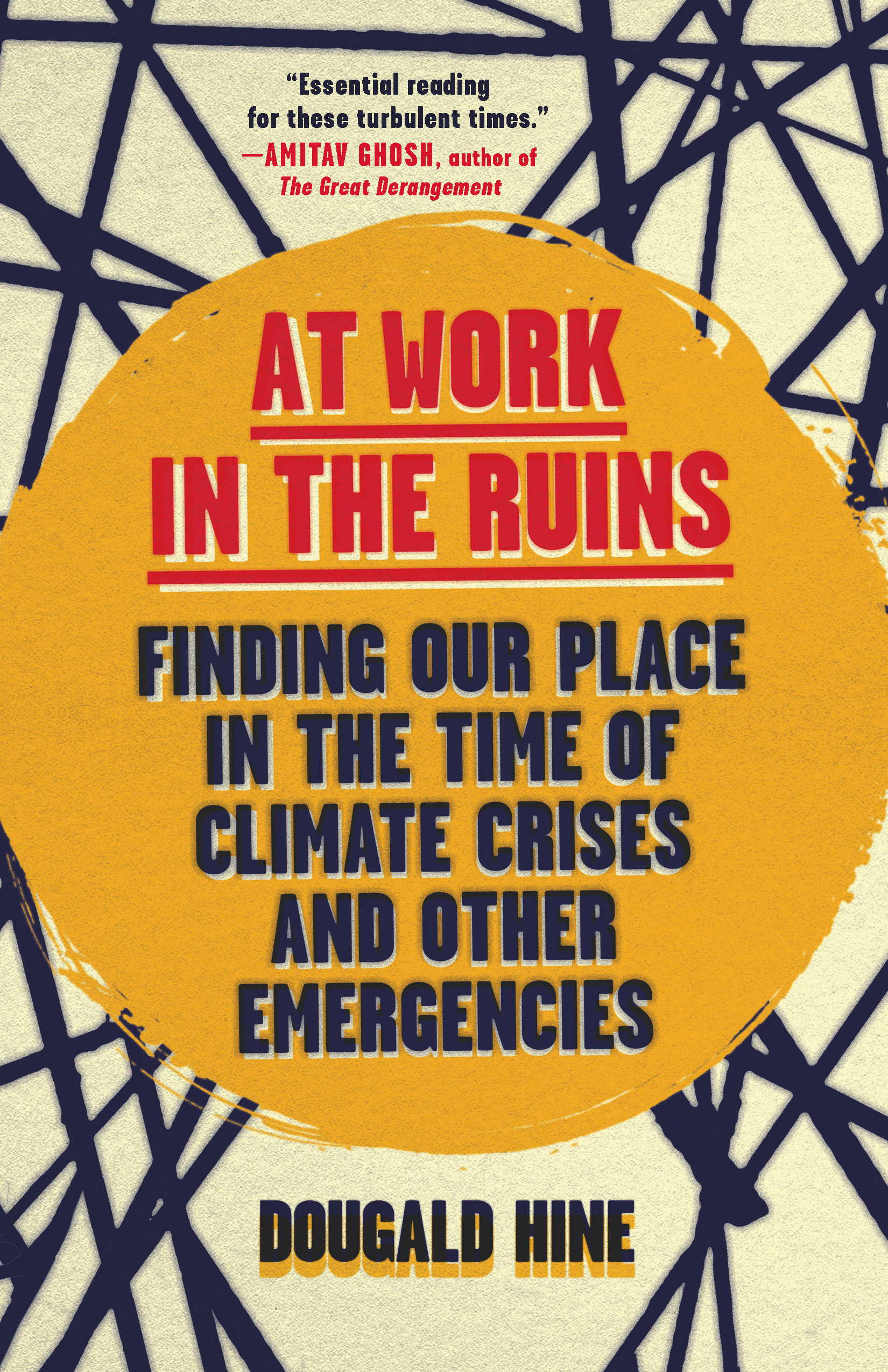
Author: Dougald Hine
Publication date: 2023
ISBN: 9781645022916
Extent: 214 pages
Part of the description from the book’s website:
““Maybe it’s time to stop talking about climate change…”
Even as I heard the words come out of my mouth, I wondered how this could possibly be true – for me, at least – and in order to answer that question, I began to write a book.For years, my work involved talking to people about climate change: on stages and on Zoom calls, on air and off the record, in essays and articles and conversations. It brought me into dialogue with scientists and policymakers, artists, activists, Indigenous thinkers and religious leaders.At Work in the Ruins is the fruit of all those encounters – but also of a moment, in the second year of the pandemic, when I began to wonder if this work still made sense.Climate change asks us questions that climate science cannot answer. Questions like, how did we end up in this mess? Is it just a piece of bad luck with the atmospheric chemistry – or is it the result of a way of approaching the world that would always have brought us to such a pass, even if the climate system had been less sensitive to our industrial emissions?How we answer such questions has consequences. But when science is turned into an object of belief and a source of overriding authority, it gets hard even to talk about the questions that it cannot answer.[…]” – go to the site to read the rest, it’s worth it!
Book website: https://dougald.nu/at-work-in-the-ruins/
Reason(s) to include in the MobileWorlds library:
This book has brought a lot of inspiration, not least about the role of science and art and how they are intertwined. And why it matters to do whatever we do, when we try to imagine futures and how to get there (which is what I’d like to contribute to “planning” being about). It also speaks to how imagination matters in profound ways, and how what we understand from what is given to us as “science” or “art”, what we choose to take on from it and how we allow it to shape our lives, makes a huge difference.
I’ll share one of my favourite quotes from the book:
“Life is not a statistical experience; it is inherently anecdotal. This is not an illusion or an error in our perception. The patterns that can be traced when lives are reduced to statistics do not reveal an underlying truth, deeper and more trustworthy than the evidence of our own experience. These patters are the footprints left on the beach across which we have walked. Read with care, they have things to tell us; but they are silent about almost everything that mattered about the day we spent together on that beach.” (p.136)