
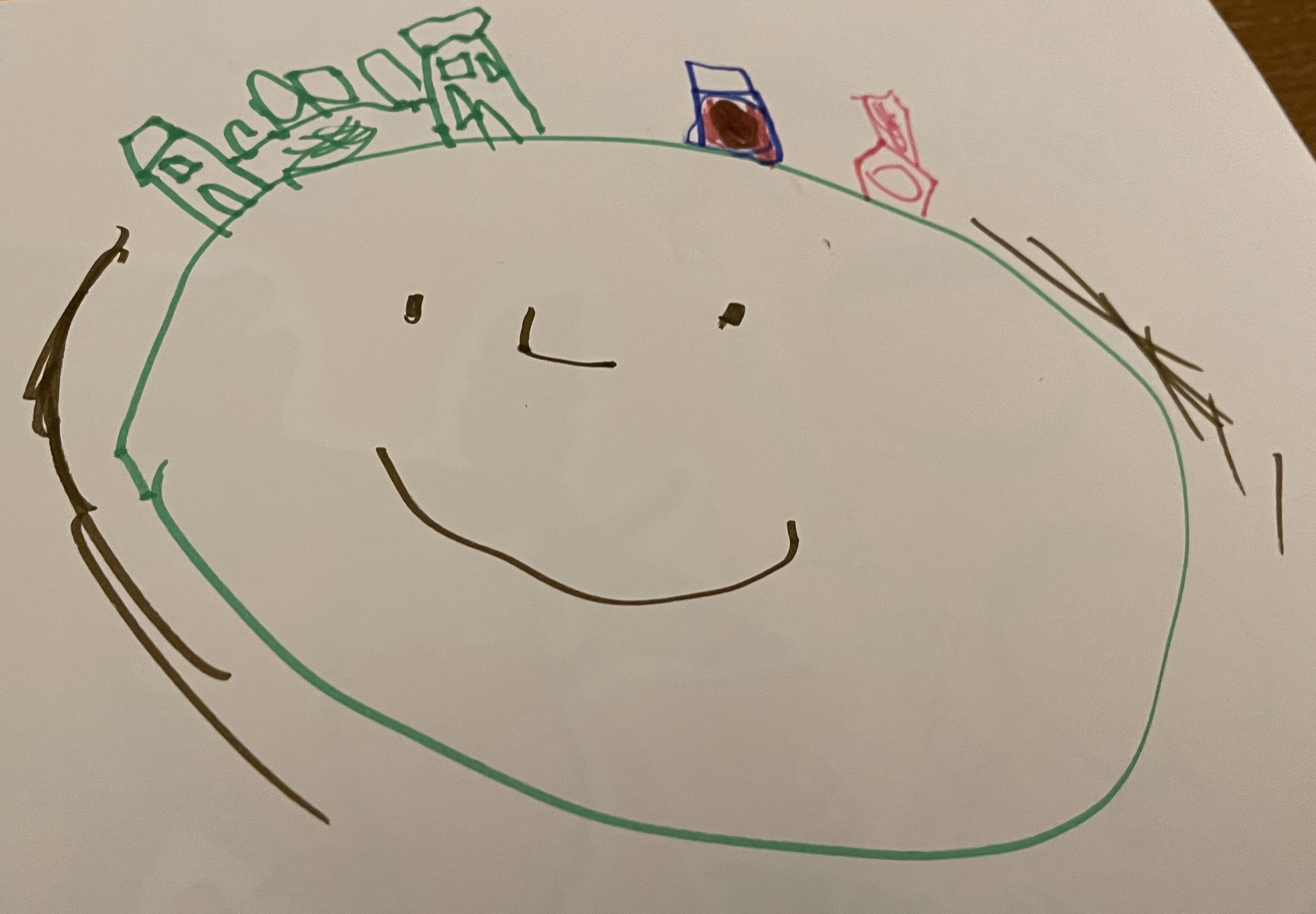
Featured image: 4-year-old child, 21 October 2023, Porto. Self-described path from home to school. Reproduced with permission from child and mother.
Last Saturday I spontaneously had the opportunity to ask a 4-year-old child, resident in Matosinhos, Portugal, to draw a picture of her path from home to school. She first drew a big circle, explaining that that was the world. Then she drew a house on one spot of the circle and said that was her home. Next, she drew another house a small way away from the one she called home, and said that was school. Then she drew a line connecting the two (the path from one to the other), and lots of messy squiggles over that path, and explained that those were all the difficult obstacles she had to pass to get there. Finally, she drew a face inside the circle and said the world was smiling, and gave it some hair too. And as we continued to talk about other things, she drew a hot chocolate and an ice-cream in a bowl with a spoon, which were of course also all on top of the world. You can see the final* result of the drawing featured above.
To complement the child’s view, let me describe her path from home to school from an adult perspective: the child’s path from home to school is about a five minute walk on the same street’s sidewalk, with a couple of crossings. Each time she makes this trip, she runs or skips, avoids the door where dogs sometimes barked at her, and looks into shop windows, says hello to frequent visitors at a café or avoids them, etc. But perhaps that is all beside the point. What she describes in her drawing is probably the important part of her experience of the path.
This was a very amateur, spontaneous drawing exercise that was not performed for the purpose of this project, but which I happened to have the chance to capture, and which made me think about three crucial aspects of the kind of expressions that Mobile Worlds aims to capture:
- Whether asking a child or an adult to draw something, it is important to ask them to explain what it is they are drawing, and what those elements mean to them. As obvious as any element in the drawing might seem to an onlooker, they might completely miss the essence of what the drawer meant otherwise.
- It is probably also important to always be aware that the drawing made today might, for all kinds of reasons, be very different from a drawing the same person may have made a day earlier or later, since the particular state of mind they are in influences which aspects they choose to highlight. This is the same for verbally shared insights or any other format, of course.
- It can be helpful to seek a diversity of angles from which a given experience can be shared. For example, when asking for drawings of a path from home to school in one occasion, to come back to the same topic with the same person later, and ask others that are familiar with the situation of that person to provide their perspective (such as my description of my perspective on the child’s home-school path, in addition to her own). Not with the objective of validating original input, but of expanding the perspective.
There is literature about methodologies for collaborating with children in design and planning (and for studying children’s perceptions of their environment in psychology and sociology), which I look forward to exploring further for Mobile Worlds. I am sure that the three points noted above are only three among many that this literature will highlight. But this post can already give a taste of how we are further developing the methodological side of Mobile Worlds!
As always, please feel free to leave comments with ideas or suggestions!
*When a drawing is “final” is rather a question of interpretation of course. At a later point the same drawing served to illustrate the path from home to a best friend’s house, and it’s probable that more elements would be added to the drawing, the page ripped and serve as bits for other things and other thoughts. But the photo captured the state of the drawing as close as possible to the moment when the conversation about the path from home to school ended.
Discover more from Mobile Worlds
Subscribe to get the latest posts sent to your email.
Leave a Reply