
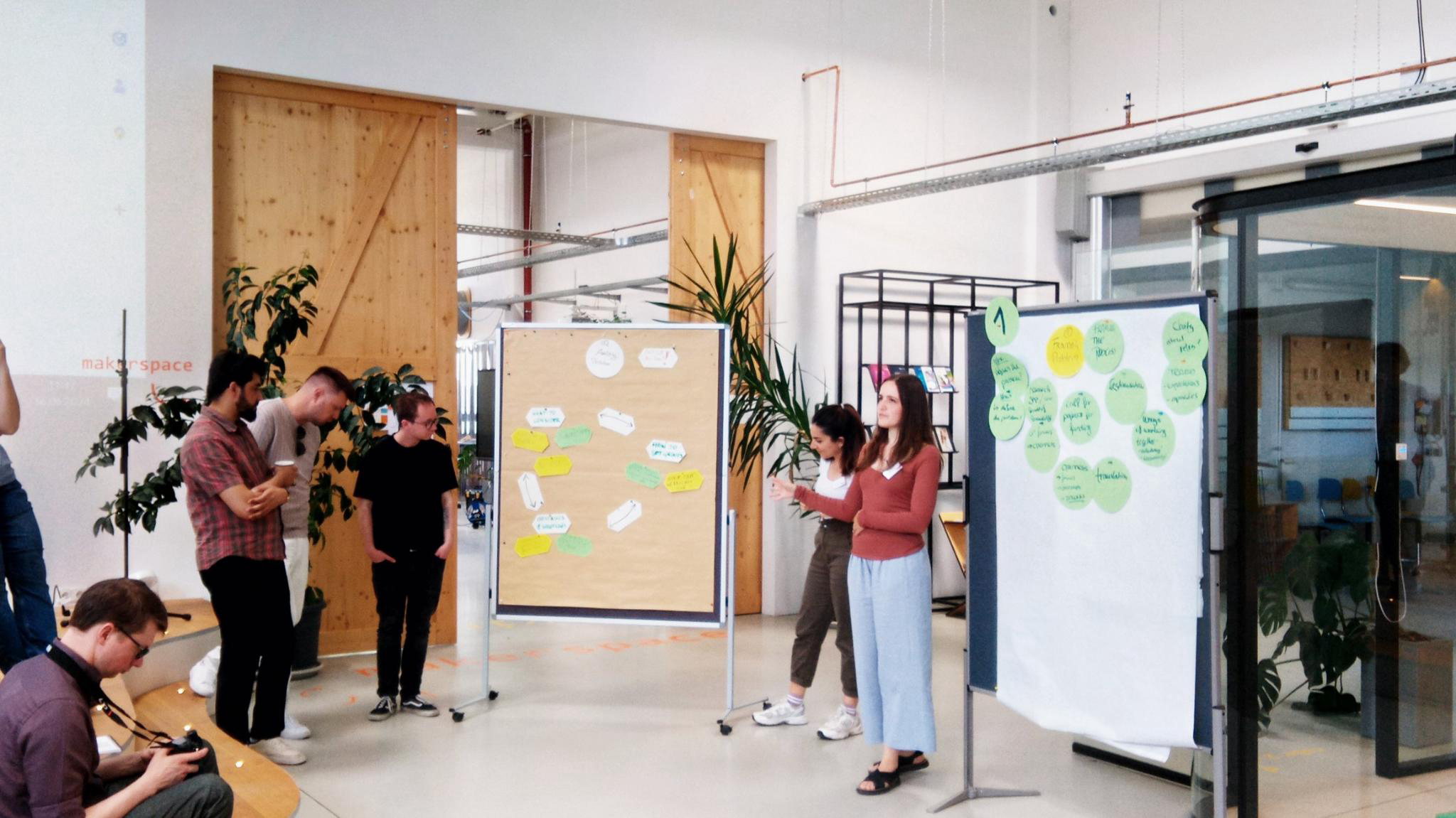
From 13-16 May Kim explored transdisciplinarity from different perspectives – between diverse academic disciplines and between academia and practice – with a wonderful group of researchers organising and participating in the IRS Spring Academy. The Academy took place in various locations: in the centre of Berlin (Germany), as well as in Beelitz and Luckenwalde, in Brandenburg – both rural areas relatively near Berlin by train. The Academy brought together participants studying fields and themes such as innovation studies, economic geography, history, mathematics, law, political science, ethnography, economics, urbanism, architecture, governance, dance, art, artificial intelligence, energy transitions, democratization, sociology, international development, and more. The program allowed horizontal interactions between people at extremely varied stages of their careers, and this in itself was very valuable. Some impressions of the Academy are shown in the slide-show above. And to share just a few take-aways for me and the Mobile Worlds project specifically (there are many more!):
- Mindsets can be extremely similar across very different disciplines (most participants seemed very closely aligned in terms of overarching norms and values, despite their extremely varied backgrounds in terms of themes studied, interests, nationalities, etc.). I must think more about what this means for “thinking otherwise” and transdisciplinarity.
- Transdisciplinarity here was conceptualised much more along the lines of working between academia and practice (based on Pohl et al 2021), while in my previous work I have also encountered the same term studied more along the lines of collaboration across disciplines within academia (which at the Academy was termed multi-discpilinarity) (see e.g. this article, and namely footnote 1 within it)
- “Identity” is a key concept that will be useful in thinking about “third cultures” in this project.
- It is important to consider closely the legacy of the concept of “culture” when applying it – across disciplines it can have very varied interpretations, some of which I had not come across before.
I look forward to staying in touch with the other participants of the Academy and to further processing what I learned! Thanks again to the organizers and participants for the lively discussions, tours and insights shared.
Leave a Reply