
This past spring Mobile Worlds went to Pontevedra, to the 10th International Degrowth Conference, as was also described in this post. There, Kim gave a presentation and held a workshop – in this post we share a little bit about both of these.
The presentation: Thinking otherwise
The presentation was entitled “Thinking otherwise. Transdisciplinary perspectives on how and why people do or do not break out of thinking patterns,” and was presented in a wonderful session on “Challenging dominant values, ideologies, and imaginaries.” The presentation zoomed in on two book chapters entitled “Thinking Otherwise”, one from Leela Gandhi’s “Postcolonial Theory: A Critical Introduction” (2019), and one from James Bridle’s “Ways of Being. Animals, Plants, Machines: The Search for a Planetary Intelligence” (2023). I explored these chapters with the following question in mind:
Instead of searching/waiting for “new” “solutions” in “technologies”, what can we find within the existing human structures of thought and action that can help the human and more-than-human condition? How and when do we think “otherwise”, and what do possible answers mean for academic research?
The review in this sense revealed the problem of binaries and the problem of generalization as key themes that can inspire future research, and that I am using to inspire my approach to the Mobile Worlds project. Sharing some ideas on this topic was really rewarding, especially given the engaged and curious audience and the surrounding presentations on the session topic. I was given several recommendations for further literature, and engaged in conversations where I could share more in-depth some of the insights that led to this presentation.
The workshop: conference success
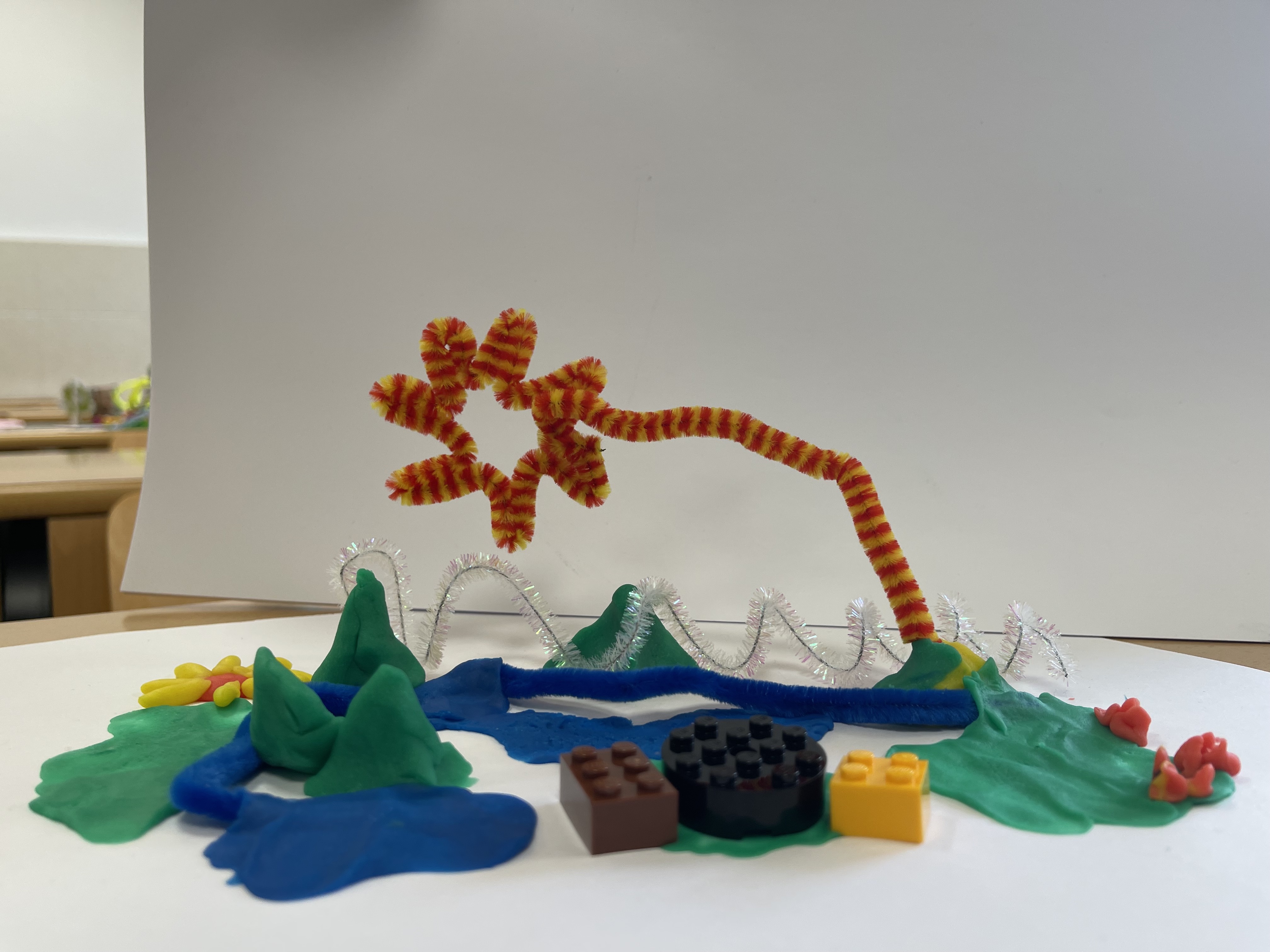
The workshop was, as always, very fun and inspiring, and this particular setting added some dimensions to the findings that had not arisen previously. It is likely that the crowd at this conference was an unusual one, compared to those the research had thus far been able to reach – likely a more creative and perhaps even more mixed-background group. The 15 participants (12 women and 3 men) were extremely creative in mixing the various materials provided – legos, collage, plasticine, and more. Themes of active but relaxed mobility came up frequently as an ideal, and the octopus came up twice as an ideal, standing for the idea of having the possibility to choose and switch between modes as appropriate and necessary; but also in terms of feeling connected to multiple cultures across various geographical spaces. For many, distant travel was considered a necessity. Cultural diversity was high, both across and beyond national cultures. Many more such insights have arisen, but I’ll have to make closer analyses and share them in upcoming Mobile Worlds analyses, to be able to be properly fair to the participants! Thank you again to all those who took part.

Important to note, in practical terms, the workshop was done in 1,5 hours rather than 3, and in a slightly different order, which worked very well and led us to adjust future workshops more to this set-up. We got very positive feedback on the workshop, as well as on the use of this kind of method and methodology at a conference, as a was to break out from narrative-based and liner discussions towards a combination of moments for individual reflection, for group hands-on activities, and then group sharing. Perhaps one interesting finding is that the Mobile Worlds workshop may well provide an especially successful format at conferences. We will be testing this again in future, at the RGS Conference at the end of August.
[The featured image is from one of the pairs that made their ideal, third culture future of mobility. Permission to use photographs of the results was given at the start of the workshop.]
Leave a Reply