
As we wrap up the MobileWorlds project, we want to highlight the ways in which we have reached out to participants of various groups and contexts, and thank them again – anonymously – for all their input! We could not have done any of this work without you, as participants – thank you so much!
We find this an important moment to share what the project has been able to achieve, and perhaps inspire future projects to reach out in diverse ways, such as the ones we applied. The types of engagement include in-person group events such as workshops and the festival; individual and online activities such as mobile interviews and the online survey; practice and general public oriented publications like the booklet, the toolbox, and features and library on the website; outreach activities like podcast episodes and interdsciplinary blog posts; and academic publications. We outline these in more detail below.
The Workshops

12 total, 4 All-Ages Workshops, 3 Planners Workshops, 2 Conference Workshops, and 3 Academic Workshops.
Except for the conference workshops, all were open to a general public, though each had their specific target group – families (all-ages), planners, and academics.
Number of participants overall: 169
The MobileWorlds workshops were designed for a variety of groups, or “communities”. We held a total of 12 workshops, with different groups, several of which could be registered for free by anyone interested, from 3 years and up. We tried to reach both established communities, through for example specific schools, and people who might be interested in creating new local communities by connecting during one of the workshops. We also further cemented emerging communities about creative workshops and creative thinking on mobilities at conferences such as the Annual Conference of the Royal Geographical Society in the UK, and at the International Degrowth Conference. We also conducted several workshops with planners, who collaborated on their visions for the future of mobility with colleagues – some who already knew each other, some who did not – and the playful character of the workshops and ways of sharing cultural details about one’s life that could be anonymous but could also be openly shared with those around if participants wished to – allowed people to get closer and become more collective reflexive. You can find out more about the workshops in the Toolkit (here), past Events (here), and previous blog posts (here).
The Festival

Event series (3 events, 6 days in 2 months)
Number of participants overall: 125, of which 27 children, and 21 joined more than one day
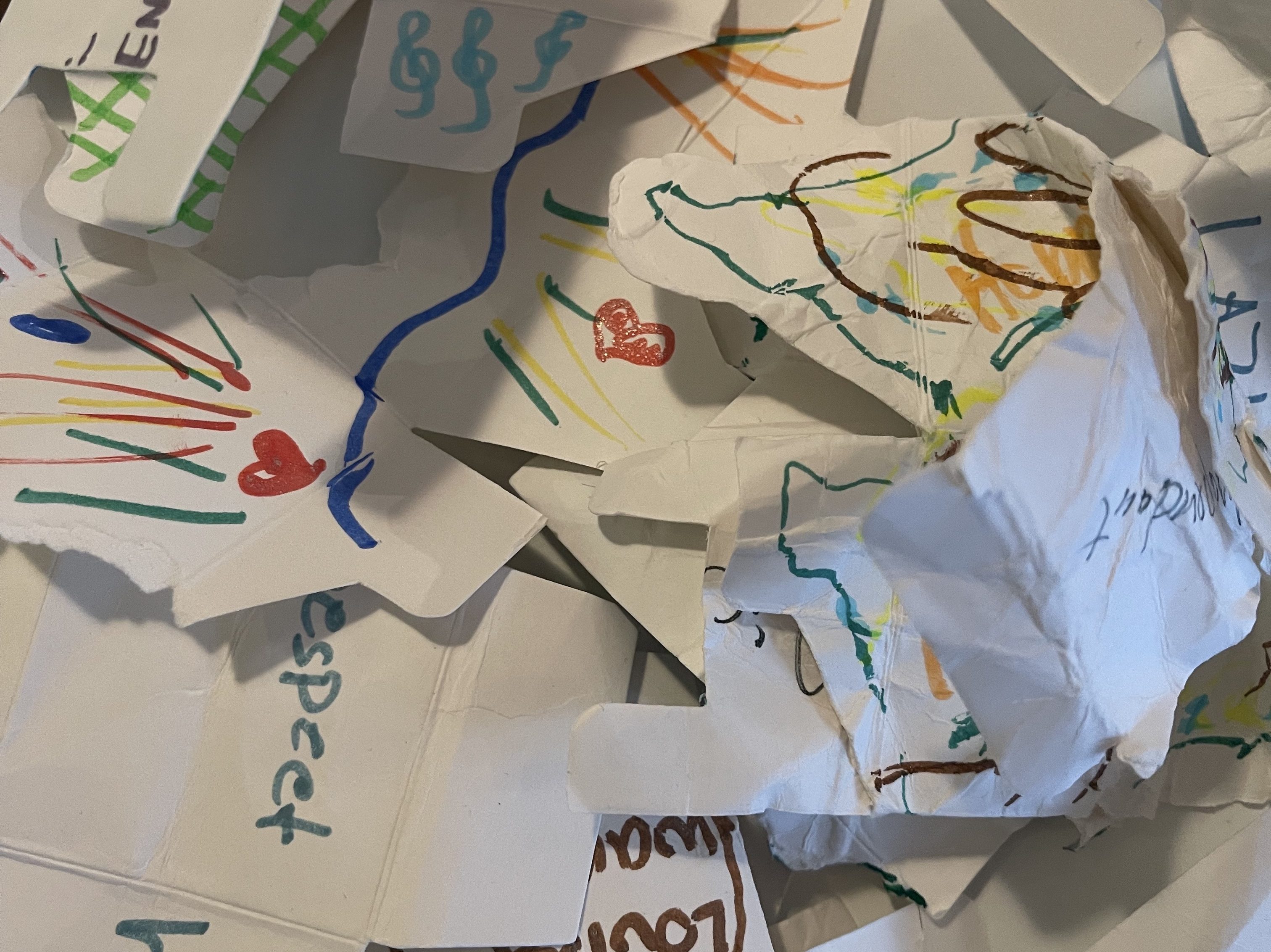
The MobileWorlds Festival joined planning practitioners, artists, photographers, and academics, as well as a general local public, bringing together people who had not been in touch before, and inviting a joint discussion about third cultures of mobilities among people of all ages. Through partly more serious conversations and even short presentations, and then fun workshops like the breaking boxes workshop and Zine workshop, we nudged most participants at one point or another slightly out of their comfort zone, to try something a little different and equal the playing field across ages and types of expertise. This allowed those people to find a common ground and build trust needed to kindle new communities, or strengthen existing ones. You can find out more about the Festival on a blog post (here), in the Toolkit (here), and on its own web-page (here).
The Toolbox

The MobileWorlds Toolbox serves to allow anyone that feels part of the Third Cultures of Mobilities Community, or would like to create one locally, can do so. It also allows people in planning practice and research to apply the key tools developed during this project in their own contexts. We are convinced that this will contribute to local community building wherever the methods are applied.
The Booklet

The MobileWorlds Booklet offers a series of insights from the project, and inspiring related contributions, as well as shares the photos commissioned for the MobileWorlds Festival and a brief description of them. The Booklet is set up in a playful way to appeal to a broad audience.
The Survey, Interviews, & Annotated Bibliography

Albeit not a method of connecting participants of the survey, as it was anonymous, this platform allowed us to introduce some people to the concept and literature of third cultures. For anyone who did identify or feel resonance with those ideas, this was an entry-point to the creation of new communities. Similarly, the interviews often introduced people to this concept, and some have reported back that it has offered them a new way to think about mobility and about the way they think about connecting across cultures. The bibliography may equally serve to introduce these themes for local community creation.
Features and Library

The MobileWorlds website includes a variety of resources, including a features page where we’ve posted about various inspiring topics for the project, and the library, where we share some of the sources – within and beyond academia – that have inspired us. Have a look and be inspired as well! The library in particular will continue to be expanded, and we are happy to receive suggestions of anything else we should include!
Minante, a New European Bauhaus Project

In parellel to the first six months of the MobileWorlds project, and in connection with the training objectives of MobileWorlds, I took part (in a small way) of the Minante project, which is a New European Bauhaus project, and which was focused on cultures of water in a specific region in the North of Portugal. Though not yet focused on the theme of mobility, the community creation through art-making, school and intergenerational involvement, and reflections on culture, was extremely inspiring for the MobileWorlds project.
Outreach activities

We also participated in a series of outreach activities, ranging from sharing some of our ideas on Marie Suazo’s podcast Talks with a Third Culture Kid Friend, on the Planetary Planning Podcast, on the Migrant Knowledge blog, an interview for HVL, alongside many conference attendances (see posts about some of there here). In this way, we also sought to connect to other existing communities in research and practice, as well as perhaps contribute to the creation of sparks for new communities to arise around Third Cultures of Mobilities. And of course, our social media and read&write sessions (see Network page) has been active throughout, and will continue to be a place for connecting people interested in these topics, and sharing outcomes of ongoing initiatives and academic results coming from this project!
Academic publications

Though focused chiefly on the academic community, several open access publications came out already in connection to the MobileWorlds project, including a critical commentary on street experiments, an article called “Questioning Streets“, an article on car-centred adultism in mobility planning in Portugal, a special issue on Cultures of Water, and reflections on rural tactical action and youth /school involvement in cultural heritage through artistic practices.
Special Issue on Third Cultures of Mobilities

We’ve set up a special issue at the Journal of Urban Mobilities, to further explore and give more substance to the theme of Third Cultures of Mobilities in the context of studies on Mobilities and Planning. Do consider submitting your work! Please send your expressions of interest / abstracts in by 13 February 2026. The full paper submission deadline is 15 August 2026. For more information click the link or check out the information below:
This special issue brings the academic debate on creative and pragmatic ways of dealing with cultural diversity and diverse methodologies deeper into mobilities research. Submission topics may include, but are not limited to:
- culturally diverse practices and/or planning for future mobilities
- cultural diversity in (im-)mobility planning and/or practices
- alternative methodologies for studying (im-)mobility planning and/or practices
- theoretical reflections on cultural diversity and “thinking otherwise” (preferably with an angle towards mobilities research)
- cross-cultural communication / vocabularies of mobility
The issue invites contributions that connect various aspects of “Third Cultures of Mobility”- those imaginaries and practices that emerge from contact between different ways of doing and thinking- and creative ways forward for mobilities research and practice.
Join the Third Cultures of Mobilities Community!
Although the project is coming to its close, we hope this is just the beginning for this community, and others interested in connecting, to flourish. We will continue to use this website and its networking platforms to further connect and inspire this community. Reach out via the form below, or by email!


Leave a Reply