
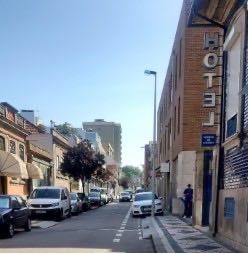
Barn mellom 3 og 12 år i Portugal pleier å bli tatt med til skolen av foreldrene i private biler. Catarina Cadima, António Ferreira og jeg undersøkte årsaker til dette, med hypotesen i tankene at kanskje foreldres frykt for trafikk, spesielt den raskt voksende bruken av elektriske scootere på fortau, kan være en nøkkelårsak til denne fortsatte praksisen. Dette var riktig, om enn på en mindre måte enn vi hadde forventet. Mange andre praktiske hensyn var viktige, noen bekreftet eksisterende litteraturs funn, noen utvidet den. Vi gjennomførte en spørreundersøkelse på fem skoler, to verkstedlignende fokusgrupper (med mye post-its!) på to skoler, og intervjuer med skoleledere ved de to sistnevnte skolene. En skole var i Matosinhos (Porto), og en annen i Braga – bildene nedenfor viser litt av hva slags gater de ble funnet.


Fokusgruppene og arbeidet med skoler og foreldre ga verdifull erfaring med hvordan man kan nærme seg og samarbeide med disse gruppene. Å utforske i dybden av årsakene til foreldrenes mobilitetsvalg for barna ga også viktig innsikt i mobilitetskulturene og tredjekulturene som er involvert i dette i Portugal, selv når dette ikke eksplisitt ble diskutert. Erfaringer utenfor Portugal dukket ofte opp som inspirerende foreldre til å prøve eller ønske seg en mer aktiv mobilitet for barna sine; det samme gjorde minner fra foreldres barndom, da det også i Portugal var mer vanlig at barn gikk til skolen, og ofte selvstendig.
Vår nylig publiserte artikkel går mer i detalj på funnene våre, og ideer for videre forskning (på engelsk):
Beyond Car‐Centred Adultism? Exploring Parental Influences on Children’s Mobility
Abstract:
Motorised traffic and car‐centric environments restrict children’s commuting patterns and outdoor activities. This has adverse health consequences as it induces physical inactivity and reduces children’s well‐being. Understanding parents’ daily routines and reasons to facilitate or restrict their children’s active and independent mobility is essential to improving children’s well‐being and encouraging environmentally sustainable mobilities. This article explores parental decision‐making processes regarding how children should travel to and from school and how these constitute barriers or enablers for children’s independent and active mobility in a Portuguese context. We used a mixed‐methods sequential approach: We first collected data through an online survey and then via focus groups with parents and interviews with school directors. Overall, parental concerns about traffic stem from an automobility‐centred culture that has converted urban streets into an optimised system of mobility flows focused on (single and employed) adults. This culture responds to the anxieties it creates by perpetuating a cycle that exacerbates existing concerns and reinforces the need to rely even more heavily on mobility technologies, especially the private car. This adult‐centred mobility culture jeopardises children’s ability to navigate the city independently while offering children a highly problematic and self‐reproducing social construction. In this construction, the risks and drawbacks of physically confined virtual environments and experiences are considered acceptable, while engaging with the physicality and sociality of the urban environment is considered unacceptably dangerous and promiscuous.
Link for full text (open access!): https://doi.org/10.17645/up.8643
Sjekk det ut! Kommentarer og ideer mottas med takk.
Legg inn en kommentar