
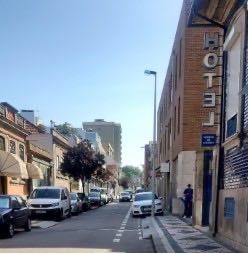
Children between 3 and 12 years of age in Portugal tend to be taken to school by their parents in private cars. Catarina Cadima, António Ferreira and I researched reasons for this, with the hypothesis in mind that perhaps parents’ fear of traffic, especially the fast growing use of electric scooters on sidewalks, might be a key cause for this continued practice. This was correct, albeit in a smaller manner than we had expected. Many other practical considerations were important, some confirming existing literature’s findings, some expanding it. We conducted a survey in five schools, two workshop-like focus groups (using lots of post-its!) in two schools, and interviews with school directors of the latter two schools. One school was in Matosinhos (Porto), and another in Braga – the photos below show a bit of the kinds of streets where they were found.


The focus groups and work with schools and parents provided valuable experience with how to approach and collaborate with these groups. Exploring in-depth the reasons for the mobility choices of parents for their children also provided important insight into the mobility cultures and third cultures involved in this in Portugal, even when this was not explicitly discussed. Experiences outside Portugal did often emerge as inspiring parents to try or wish for a more active mobility for their children; as did memories from parents’ on childhood, when also in Portugal it was more common for children to walk to school, and often independently.
Our recently published article goes into more detail on our findings, and ideas for further research:
Beyond Car‐Centred Adultism? Exploring Parental Influences on Children’s Mobility
Abstract:
Motorised traffic and car‐centric environments restrict children’s commuting patterns and outdoor activities. This has adverse health consequences as it induces physical inactivity and reduces children’s well‐being. Understanding parents’ daily routines and reasons to facilitate or restrict their children’s active and independent mobility is essential to improving children’s well‐being and encouraging environmentally sustainable mobilities. This article explores parental decision‐making processes regarding how children should travel to and from school and how these constitute barriers or enablers for children’s independent and active mobility in a Portuguese context. We used a mixed‐methods sequential approach: We first collected data through an online survey and then via focus groups with parents and interviews with school directors. Overall, parental concerns about traffic stem from an automobility‐centred culture that has converted urban streets into an optimised system of mobility flows focused on (single and employed) adults. This culture responds to the anxieties it creates by perpetuating a cycle that exacerbates existing concerns and reinforces the need to rely even more heavily on mobility technologies, especially the private car. This adult‐centred mobility culture jeopardises children’s ability to navigate the city independently while offering children a highly problematic and self‐reproducing social construction. In this construction, the risks and drawbacks of physically confined virtual environments and experiences are considered acceptable, while engaging with the physicality and sociality of the urban environment is considered unacceptably dangerous and promiscuous.
Link for full text (open access!): https://doi.org/10.17645/up.8643
Do check it out! Comments and ideas very welcome.
Leave a Reply